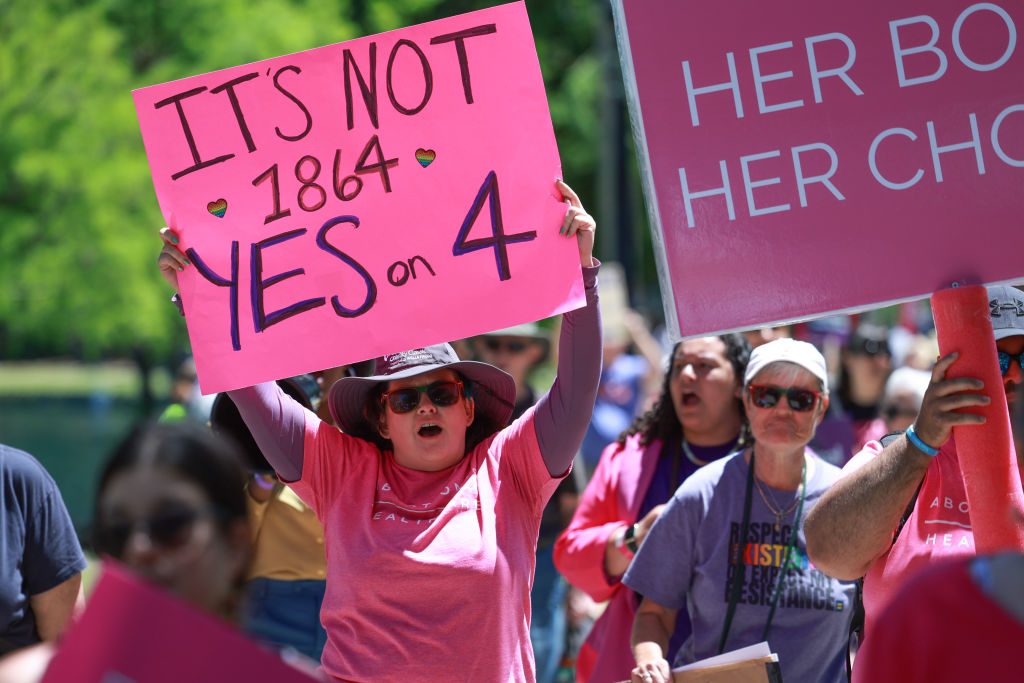
Photo by Joe Raedle/Getty Images
She faced one of the toughest decisions of her life as she navigated Florida’s abortion restrictions. Now she’s speaking out against them and in support of Amendment 4.
Ariel Okhah Cavanaugh faced one of the toughest decisions of her life when she had to decide whether to carry to term a pregnancy that was fraught with fetal medical issues or terminate the pregnancy that she and her husband very much wanted.
“My husband and I had our first son in December of 2020. So, when he was about 18 months old, we thought we were ready to have another. We really wanted them close in age, and so we tried, and we successfully got pregnant,” the licensed clinical social worker, now a stay-at-home mom of two, told Floricua.
“I went to the doctor, I think I was about eight weeks, seven weeks, just to make sure. I had had an ectopic pregnancy before my son was born, so it was really important that I make sure that the embryo was in the right place,” she remembers. “So I went, and the embryo was in the right place.”
But further testing revealed that the fetus showed high levels of Trisomy 21, or Down’s Syndrome, a genetic disorder usually associated with developmental delays, and mild to moderate intellectual disability.
After a Chorionic Villus Sampling (CVS) test – a prenatal test used to detect birth defects, genetic diseases, and other problems during pregnancy – and the assurance from her doctor that she could travel to Germany, the family went abroad to visit friends in late 2022.
A heartbreaking decision
Then came the news that no expectant parents want to hear. In Germany, two weeks after her doctor’s visit in Florida, an ultrasound showed serious medical issues had developed and were affecting the fetus.
“There was pooling in the brain. There was fluid in the actual brain. The doctor said he found a cardiac defect, but at that point, the structures hadn’t developed enough for him to say how severe that defect was,” says Okhah Cavanaugh. “The gastrointestinal system was so poorly developed and was so, so bad, that he said, ‘If I saw just this alone, I would recommend a termination.’ And so, at that point, we knew that this was a pregnancy that was very sick.”
After thoughtful consideration, the couple decided to terminate the pregnancy and tried to find quickly as soon as possible.
At that point, however, Okhah Cavanaugh was more than 15 weeks pregnant, barring her from having the procedure in her home state of Florida, where at the time, Gov. Ron DeSantis’ 15-week abortion ban was in place.
RELATED: ‘We’re told to do malpractice’: Florida doctor highlights devastating impacts of six-week abortion ban
“And so, I called the Maternal Fetal Medicine doctor, and I just said, ‘Can I get some clinic options?’ They gave me a couple of clinics. I called those clinics, and they just didn’t care to actually help at all, you know, they kind of washed their hands of me and just said, ‘Let us know if you’ll need us’, but [that] I need to come back and see a doctor because at this point it would be considered high risk. ‘Otherwise, we can’t help you’.”
It was December 23rd and time was running out.
“It was between Christmas and New Year’s, a lot of clinics closed at that point, you know. There were other states that had abortion bans and so these waitlists were just so long.”
After a frantic search, the couple finally found a hospital in Boston that was willing to take them, so Okhah Cavanaugh and her husband changed their flights and flew from Germany to Boston, where she had an abortion.
“My husband is a doctor, so I was really lucky. But people shouldn’t be able to access health care just because they have resources or just because they have pull,” she said.
Poor pregnancy outcomes or pregnancy complications don’t only happen to women with means or women without means, said Okhah Cavanaugh.
“I could have all the money in the world, but if I can’t get to somewhere where they’re going to treat me, I can still die. We live in Miami and looking at the map of how far I would have to go to get the health care I needed if something did happen, it’s really far, and no amount of money can give me that time.”
‘It’s frightening’
The experience left Okhah Cavanaugh shaken, and with a real sense of the serious consequences the state’s even more restrictive six-week abortion ban that went into effect May 1 of this year.
“It’s frightening. After my abortion, I had two subsequent miscarriages, and I’ve had an ectopic pregnancy,” says Okhah Cavanaugh. “So, I know that pregnancies don’t always have a healthy baby at the end of it,” she said.
RELATED: Florida doctor says 6-week abortion ban is ‘jeopardizing future of healthcare in Florida’
Terminations for medical reasons (TMR) are three times more common than stillbirth and infant loss combined, said Okhah Cavanaugh. For this reason, “these abortion restrictions and these abortion bans hurt women, and they hurt children, they hurt families.”
A strong proponent of Amendment 4 – the grassroots initiative on the ballot in November that would enshrine the right to abortion until fetal viability (usually around 24 weeks of pregnancy) in the state Constitution – Okhah Cavanaugh believes women’s health care is strictly between a patient and her doctor.
“We did what we felt was the kindest, most merciful thing. And oftentimes people say, ‘Well, I wouldn’t have done that’. And that’s ok,” she said. “Maybe you wouldn’t do that. And that’s valid. But just because you wouldn’t, doesn’t mean I shouldn’t be able to. We made that decision with the deepest love and compassion for all parties involved.”
After talking to her Republican representative in Miami Beach, Okhah Cavanaugh is more convinced than ever that legislators have no business in the exam room with the doctor and her patient.
“A lot of [legislators] hear my story and they’re like, ‘Oh, the exceptions, we’ll, we’ll give you an exception. Based on your story you’d qualify.’ But I didn’t qualify. When you’re making these rules and these policies, it’s really hard to account for nuance. It’s really hard to draw a line because that line should be dictated and upheld by the doctors that know better,” she said.
In April of 2024, the couple welcomed a baby into the family.
Author
Support Our Cause
Thank you for taking the time to read our work. Before you go, we hope you'll consider supporting our values-driven journalism, which has always strived to make clear what's really at stake for Floridians and our future.
Since day one, our goal here at Floricua has always been to empower people across the state with fact-based news and information. We believe that when people are armed with knowledge about what's happening in their local, state, and federal governments—including who is working on their behalf and who is actively trying to block efforts aimed at improving the daily lives of Florida families—they will be inspired to become civically engaged.

People are leaving states with abortion bans, according to study
A new analysis from the National Bureau of Economic Research found that since 2022, states with near-total abortion bans appear to have lost 36,000...

The fight for reproductive justice in Florida is ‘not over,’ say advocates
"We're going to ensure that our voices are heard," says Charo Valero of the National Latina Institute for Reproductive Justice, who spoke with...

Decline of Florida’s citrus industry hastened by Trump’s tariff tiff
Hurricanes and disease have already taken a tremendous toll on those fragrant trees, not to mention development demand for the land. This weekend I...

You may qualify to file your taxes for free in Florida—here’s how
An estimated 3.2 million Floridians will be eligible to use the IRS Direct File program to file their taxes this year. Floridians have some good...