
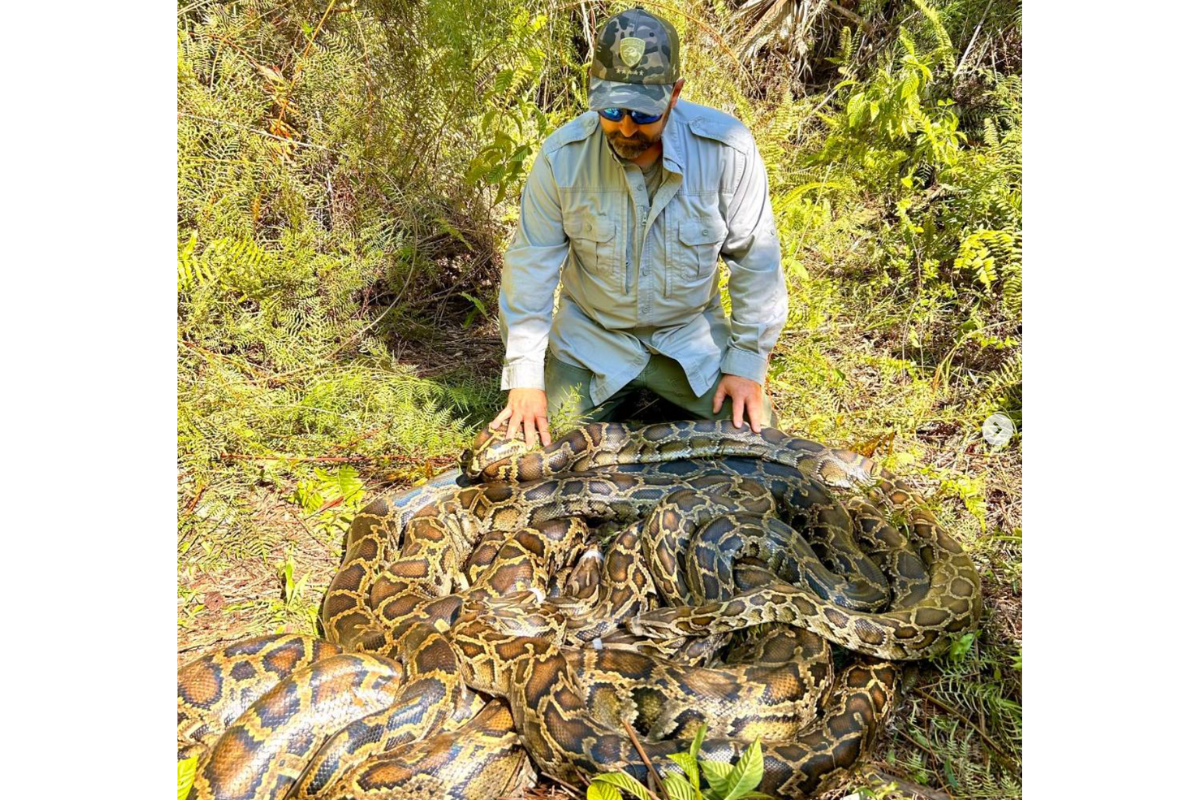
Image via Conservancy of Southwest Florida
Burmese pythons have no natural predators and have contributed to the decline of racoon, opossum, and bobcat populations in the state.
A team of wildlife conservationists found a pile of mating Burmese pythons, weighing a total of 500 pounds and measuring seven feet wide, in a marsh near Naples last month.
The recent tracking mission, which captured 11 Burmese pythons, including a 16-foot female, was part of the Conservancy of Southwest Florida’s program to hunt down the invasive species. Burmese pythons have no natural predators and have contributed to the decline of racoon, opossum, and bobcat populations in the state.
“It’s probably most people’s worst nightmare, but for us, it’s a good day. It’s a win for native wildlife,” Conservancy biologist Ian Bartoszek told the Miami Herald.
The invasive species is considered one of the most concerning in Florida, especially in the Everglades National Park. What’s even more alarming is that pythons have been migrating throughout the state ever since an established breeding population was first documented in 2000, according to a comprehensive review of python science published last year by the U.S. Geological Survey. Pythons have already reached West Palm Beach and Fort Myers, and are now headed toward Central Florida.
To locate the pythons, staff from the Conservancy put implant trackers in male “scout snakes” and set them free in remote areas. As of September 2023, biologists and project volunteers from the Conservancy have removed over 30,000 pounds of pythons from an approximately 150 square mile area in southwestern Florida.
“For 10 years, we’ve been catching and putting them down humanely,” Bartoszek said. “You can’t put them in zoos and send them back to Southeast Asia. Invasive species management doesn’t end with rainbows and kittens. These are remarkable creatures, here through no fault of their own. They are impressive animals, good at what they do.”
RELATED: 7 non-native species wreaking havoc in Florida
Author

Politics
Housing market cools along Florida’s Gulf Coast
The uptick in the construction of new housing followed the influx of newcomers to Florida during the pandemic, but that boom is now tapering off....

Get ready, Orlando: Westcourt District promises thrilling entertainment, more
The district will be built in an 8.5-acre complex next to the Kia Center at West Church Street and South Hughey Avenue. Orlando residents and...
Local News
Housing market cools along Florida’s Gulf Coast
The uptick in the construction of new housing followed the influx of newcomers to Florida during the pandemic, but that boom is now tapering off....
Get ready, Orlando: Westcourt District promises thrilling entertainment, more
The district will be built in an 8.5-acre complex next to the Kia Center at West Church Street and South Hughey Avenue. Orlando residents and...


